
What Parents Notice First
Most parents who come to us about vertical growth concerns describe the same things. Their child’s face looks longer than other kids the same age. The lower third of the face — from the nose to the chin — seems stretched. Their child’s lips sit apart at rest, and closing them takes visible effort. Breathing happens through the mouth, especially during sleep.
Pediatricians sometimes call this “adenoid facies” or “long face syndrome.” Orthodontists call it a hyperdivergent growth pattern. The clinical name matters less than what it means for your child: the lower jaw is growing downward and backward instead of forward. Left alone, this pattern gets worse during the growth spurt (typically ages 10–14) and can lead to an open bite, chronic mouth breathing, and a facial profile that becomes difficult to correct without surgery after growth ends. For a complete overview of how orthodontics addresses breathing and sleep problems across all ages, see our airway orthodontics page.
The vertical pull chin cup intercepts that pattern while your child’s bones are still growing. It works alongside other appliances like a palate expander and eventually braces — addressing the vertical component that other appliances cannot.
How the Vertical Pull Chin Cup Works
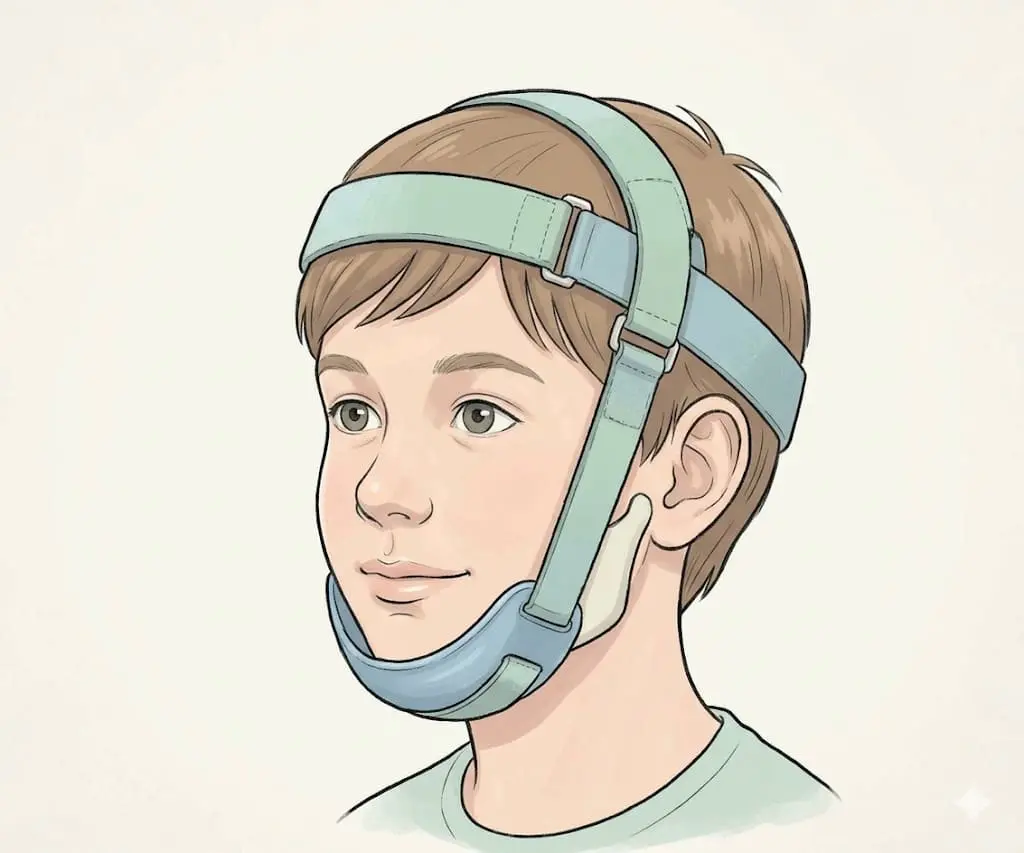
A padded cup sits under your child’s chin. Adjustable straps wrap over the top of the head, pulling the chin upward — straight up, perpendicular to the biting surface. That vertical force does two things: it limits how far the lower jaw can grow downward, and it encourages the jaw to rotate forward instead of continuing its downward drift.
The force is gentle but consistent — about 300–500 grams per side, similar to the weight of a soup can. Your child wears it 12–14 hours per day, at home and during sleep. It is not worn to school, sports, or social activities.

What the Chin Cup Does NOT Do
Vertical Pull ≠ Occipital Pull
Children Who Benefit from the Vertical Pull Chin Cup
Not every child with an open bite or mouth breathing needs a chin cup. Dr. Viecilli evaluates the skeletal measurements on your child’s 3D CT scan — mandibular plane angle, lower facial height ratio, and gonial angle — before recommending this appliance. Candidates typically share several of these characteristics:
Increased Lower Face Height
Open Bite or Tendency
Mouth Breathing at Rest
Downward & Backward Growth
Age 7–12 & Still Growing
Adequate Compliance
What to Expect During Treatment
Free Consultation + 3D CT
CBCT scan, skeletal measurements, vertical growth assessment. Diagnosis, treatment plan, and exact pricing. No charge, no deposit.
Appliance Fitting
Custom-fitted to your child’s head. Straps adjusted for truly vertical force. Dr. Viecilli calibrates to 300–500 grams per side using a force gauge.
Home Wear (12–14 hrs/day)
Worn at home and during sleep. Off for school, meals, sports, and brushing. Most children adjust within a week. Mild chin soreness for 2–3 days.
Progress Monitoring
Vertical growth is checked every 6–8 weeks. Force level and strap position are adjusted as your child grows. Cephalometric measurements at intervals.
Transition to Next Phase
Once vertical control is established (6–18 months), the chin cup is phased out. Treatment continues with braces. Some children continue nighttime wear.
Long-Term Monitoring
Vertical patterns can reassert during pubertal growth spurt. Dr. Viecilli monitors through adolescence and adjusts the plan if needed.
What the Research Shows
Pearson (Angle Orthodontist, 1986) evaluated 79 patients treated with a vertical-pull chin cup and found close to 10 degrees of mandibular plane angle closure — enough to redirect the jaw from a downward growth path toward forward rotation, shorten the face, and improve lip seal. His earlier work (1973, 1978) established the biomechanical rationale. Iscan et al. (AJODO, 2002) confirmed open bite correction through mandibular forward rotation and posterior eruption inhibition. Schulz and McNamara (AJODO, 2005) and a 2014 meta-analysis (Chatzoudi et al., 120 patients across five studies) further validated these findings in controlled settings.
Why Most Orthodontists Do Not Offer This
Most residency programs spend very little time on vertical growth modification with extraoral appliances. The focus of modern training is on aligners, fixed appliances, and TADs. As a result, the majority of practicing orthodontists do not diagnose hyperdivergent growth patterns early enough, do not stock vertical-pull chin cups, and do not have experience managing the multi-phase protocol. If your child was evaluated by another orthodontist and told to “wait and see” or offered braces without any plan for vertical control, that is a common gap in training — not a reflection of your child’s treatment options.
The Honest Takeaway
How the Chin Cup Fits into a Larger Plan
The chin cup is rarely used alone. For most children with vertical growth problems, Dr. Viecilli designs a phased treatment plan that addresses all three dimensions — width, front-to-back position, and vertical height: