
Why Do Braces Take So Long?
Most comprehensive braces cases run 18 to 24 months because standard archwires apply the same force to every tooth. Incisors are small with thin roots. Molars are large with multiple roots.
When the same wire pushes on both, it overpowers the small teeth (causing a lag phase where the bone around them shuts down) and underpowers the large teeth, which barely move. The orthodontist compensates by changing wires multiple times. Typically four to six progressions.
Each one is a separate office visit and a new cycle of biological adaptation.
The lag phase is the single biggest bottleneck in orthodontic treatment. When the periodontal ligament receives too much force, the tissue dies temporarily (hyalinization), and no movement happens until the body clears the damaged tissue. This can stall a single tooth for weeks and push finishing adjustments later into the schedule.
Accelerated orthodontics is the broad term for any technique that shortens treatment time beyond conventional protocols. Some approaches are supported by strong clinical evidence.
Others are marketed aggressively but fail to outperform standard mechanics in randomized trials. Limestone Hills Orthodontics takes an evidence-first approach: the acceleration techniques offered in Austin are the ones that have survived independent scrutiny in the published literature, and the ones that have not are openly discussed so families can decide with full information.
SmartArch™: 7 Force Zones, One Wire
SmartArch™ is an orthodontic archwire with multiple programmed stiffness zones that deliver precisely calibrated forces to each tooth based on how much movement is needed. SmartArch™ uses laser vaporization of nickel atoms to create up to 10 distinct stiffness levels within a single wire.

The result: each tooth receives force matched to its root size and periodontal ligament capacity. Small teeth get gentle force. Large teeth get firm force. No tooth is overpowered. No tooth is underpowered. The lag phase is minimized, and teeth begin moving simultaneously from day one.
| Metric | Result | Source |
|---|---|---|
| 50% | Faster leveling & alignment | Olsen, JCO 2020 |
| 56% | More corrections at the same time | Roberts et al. |
| 2 | Wires instead of 4–6 | SmartArch™ 2-step sequence |
| $0 | Extra cost at Limestone Hills Orthodontics | Included with every case |
Published Clinical Evidence
Olsen (JCO 2020): SmartArch™ treatment minimized the lag phase and led to an estimated 50% savings in leveling and alignment time across multiple bracket systems.
Roberts et al: SmartArch™ 0.016″ round demonstrated 56% more correction and 20% less time versus standard CuNiTi in .018″ slot brackets.
Viecilli & Burstone (AJO-DO 2015): Foundational finite element analysis establishing the ideal force levels for each tooth. The research SmartArch™ programming is based on.
Two published RCTs (PMC10811358, PMC11698240): Multicenter randomized controlled trials validating SmartArch™’s clinical performance.
Why Most Practices Don’t Carry SmartArch™
SmartArch™ is significantly more expensive than standard nickel-titanium wires, and supply is limited. Most practices either don’t know about it or choose not to absorb the cost. Every braces patient at Limestone Hills Orthodontics receives SmartArch™ at no extra charge, with pricing below competitors.
Micro-Osteoperforations: Optional Add-On for Maximum Speed
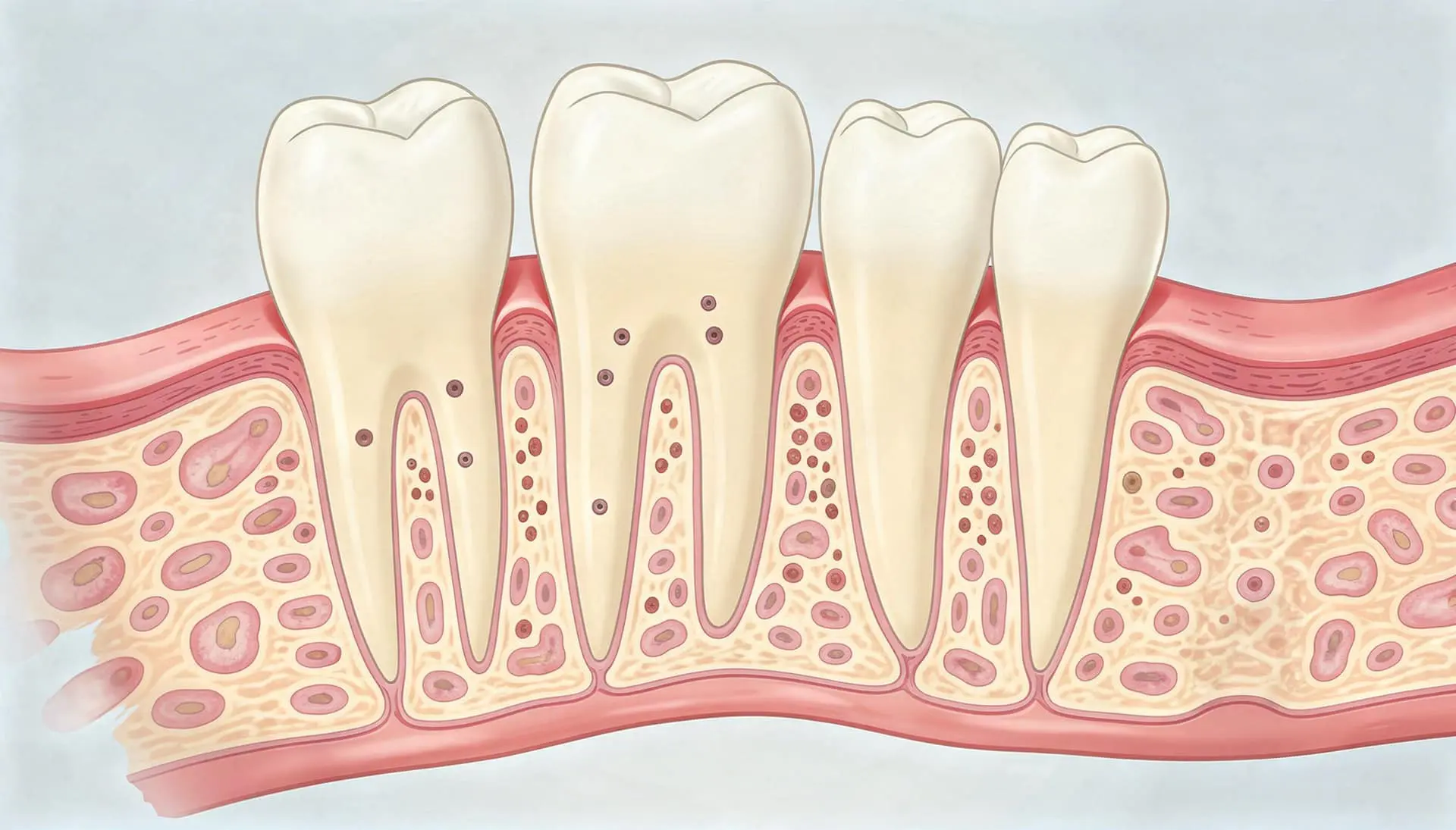
Micro-osteoperforations (MOPs) are tiny pinpoint perforations made in the cortical bone near the teeth being moved. The procedure takes about 5 minutes during a regular adjustment visit, is performed under local anesthesia, and patients report minimal discomfort. Comparable to a routine braces tightening.
How MOPs Work
When the body detects micro-trauma in bone, it triggers the Regional Acceleratory Phenomenon (RAP). A localized surge in bone turnover that temporarily reduces cortical bone density in the area. This makes it easier for teeth to move through the bone. Published research shows MOPs can increase the rate of tooth movement by 1.5 to 2 times compared to orthodontic forces alone.
What the Evidence Says
Multiple systematic reviews have been published on MOPs. The results are promising but mixed. Animal studies consistently show significant acceleration. Human clinical trials show moderate acceleration (1.5–2×) in most studies, though a 2021 meta-analysis of low-bias RCTs found no significant difference with a single application.
The most favorable results come from repeated MOPs over the course of treatment rather than a single session.
At Limestone Hills Orthodontics, Dr. Viecilli recommends MOPs selectively. For patients where the clinical benefit justifies the additional procedure. MOPs are not a replacement for good biomechanics, but they can complement it when maximum speed is the priority.
What MOPs Do Not Do
MOPs accelerate tooth movement through existing bone. They do not change jaw growth, correct skeletal problems, or replace the need for proper biomechanics. If the wire is delivering the wrong force, moving teeth faster through bad mechanics produces bad results faster.
Corticotomy & Bone Grafting: For Complex Cases
For patients who need the strongest surgical acceleration. Or who need bone augmentation to move teeth safely into thin bone. We coordinate corticotomy and bone grafting procedures with Dr. Andrew Verrett at Austin Periodontal Associates. This is the most evidence-supported surgical acceleration technique in the literature, producing 2–3× faster tooth movement.
In a corticotomy, the periodontist makes small cuts in the cortical bone around the teeth being moved and places bone graft material to thicken the bone envelope. This triggers a more intense Regional Acceleratory Phenomenon than MOPs alone and simultaneously builds bone volume. This is critical when teeth need to be moved into areas where bone support is thin.
Corticotomy is more invasive than MOPs and requires a separate surgical appointment. It is reserved for cases where the clinical benefit is substantial. Adult patients with dense bone, complex movements into compromised bone, or situations where treatment time reduction of 40–60% is worth the added procedure.
What Actually Shortens Treatment Time
Outside of the surgical and wire-based techniques described above, the single most reliable way to shave months off a braces or aligner case is to eliminate the appointments and biological delays that quietly stretch treatment. Dr. Viecilli focuses on several evidence-supported levers that do not rely on additional procedures or unproven hardware.
Precise Biomechanics and Wire Selection
Choosing the right wire sequence for each patient matters more than using any single branded acceleration product. Dr. Viecilli selects wires case-by-case rather than using a fixed one-size-fits-all progression, and the practice documented its wire rationale in response to the questionnaire: treatment typically begins with a light nickel titanium wire for initial alignment, progresses through heavier rectangular nickel titanium for torque control, and finishes with stainless steel or TMA for detailing. SmartArch™ is the practice’s default arch wire. Dr. Viecilli co-invented the wire with Dr. Charles Burstone, and the design varies the force along the length of a single wire so each tooth receives a biomechanically calibrated load. Traditional wires apply the same force to every bracket, which leaves some teeth under-loaded and others over-stressed. Limestone Hills supplements with NiTi and TMA wires for stages and movements SmartArch™ is not designed for.
This matters for speed because a wire that delivers the wrong force for a given stage of treatment is, by definition, time being wasted. Light forces on aligned teeth accomplish nothing. Heavy forces on crowded teeth trigger the lag phase. The point of case-specific wire selection is to keep every tooth under biologically appropriate force throughout treatment so movement never stalls.
Self-Ligating Ceramic Brackets (Aesthetic Cases)
For patients who choose clear braces, Limestone Hills Orthodontics uses GC Orthodontics Self-Ligating Ceramic (Japanese monocrystalline). Limestone Hills uses self-ligating brackets only on the ceramic system. The clear ceramic brackets have a built-in metal gate that holds the wire without elastic ties, which keeps the brackets transparent from bonding day to removal day. The metal brackets still use traditional elastic ties because metal-braces patients, especially teens, ask for the colored bands at every adjustment. Self-ligating gates are not magically faster than elastic ties. Treatment time depends far more on case complexity, root anatomy, and wire selection than on bracket-ligation type.
Self-ligating ceramic brackets do not dramatically accelerate tooth movement compared with well-tied conventional brackets. The RCT evidence on speed is modest and inconsistent. But they do reduce friction at the bracket-wire interface and eliminate the elastic ties that would otherwise discolor over a twelve-to-eighteen-month case.
For patients choosing ceramic for aesthetic reasons, self-ligation is a direct upgrade that preserves how the appliance looks from bonding up through debonding.
CBCT-Integrated Digital Planning
Every comprehensive case at Limestone Hills Orthodontics begins with a cone-beam CT (CBCT) and intraoral scan, so the treatment plan is built on the patient’s actual anatomy. Root position, airway volume, bone thickness, and TMJ architecture. Rather than on a two-dimensional panoramic estimate.
Digital planning up front lets the orthodontist anticipate biomechanical obstacles before they appear clinically: a thin cortical plate that would slow premolar retraction, an impacted canine that will need early exposure, and a sinus close to an extraction site.
Catching those issues before bond-up is the difference between a case that finishes on schedule and one that stalls mid-treatment for an imaging redo.
Acceleration Methods: What Works and What Doesn’t
The market for accelerated orthodontics includes several approaches. Some are backed by strong evidence, others by marketing. Here is an honest comparison:
| Method | How It Works | Evidence Level | Typical Cost | At Limestone Hills Orthodontics |
|---|---|---|---|---|
| SmartArch™ Wire Included Free | Variable-force archwire delivers optimized force to each tooth, minimizing lag phase | Strong. Peer-reviewed case series + 2 RCTs | $0 extra at Limestone Hills Orthodontics; premium pricing elsewhere | ✅ Every braces patient |
| Micro-Osteoperforations Optional | Tiny bone perforations trigger RAP. Localized increase in bone turnover | Moderate. Systematic reviews show 1.5–2× acceleration; mixed RCT results | $500 per site | ✅ Optional add-on |
| Corticotomy / PAOO Available | Surgical cuts in cortical bone + bone grafting; raises mucoperiosteal flap. Performed by periodontist | Moderate-strong. 2–3× acceleration; most invasive but strongest surgical evidence | $1,500–$3,000+ | ✅ Coordinated with Dr. Andrew Verrett |
| Low-Level Laser Therapy | Photobiomodulation aimed at stimulating cellular activity in the PDL | Low-moderate. Inconsistent outcomes across protocols | $500–$2,000 | ❌ Not offered. Evidence insufficient |
| Vibration Devices Not Recommended | Mouthpiece producing micro-vibrations (AcceleDent, VPro5) | Weak. Multiple RCTs show no significant acceleration; the manufacturer of AcceleDent ceased operations | $800–$1,000 | ❌ Not offered. No evidence of benefit |
| Piezocision | Ultrasonic bone cuts through gum tissue without raising a flap | Moderate. Limited human RCTs | $1,000–$2,500 | Discussed case-by-case |
| Optimized Aligner Change Frequency | Assessing tooth-movement completion via remote monitoring rather than a fixed 14-day calendar; faster changes when teeth are already tracking | Moderate. Supported by aligner manufacturer data and remote-monitoring studies | Included in the aligner treatment fee | ✅ Standard for aligner patients |
Why Limestone Hills Orthodontics Does Not Offer Vibration Devices
AcceleDent and similar vibration-based devices were marketed aggressively to orthodontic practices and patients for most of the 2010s.
Multiple systematic reviews and randomized controlled trials have since concluded there is no consistent evidence that vibration accelerates orthodontic tooth movement, and AcceleDent’s manufacturer has ceased operations. Limestone Hills Orthodontics does not charge patients $800–$1,000 for a device that has not outperformed placebo in the better-designed studies.
Why Low-Level Laser Therapy Is Not Standard Here
Photobiomodulation with low-level laser has shown some positive signals in smaller trials, but protocols vary dramatically (wavelength, dose, application interval) and the systematic reviews continue to find inconsistent results. Until the evidence base stabilizes, Limestone Hills Orthodontics prefers acceleration techniques with more reproducible outcomes and does not charge for LLLT as a separate adjunct.
How Accelerated Treatment Works at Limestone Hills Orthodontics
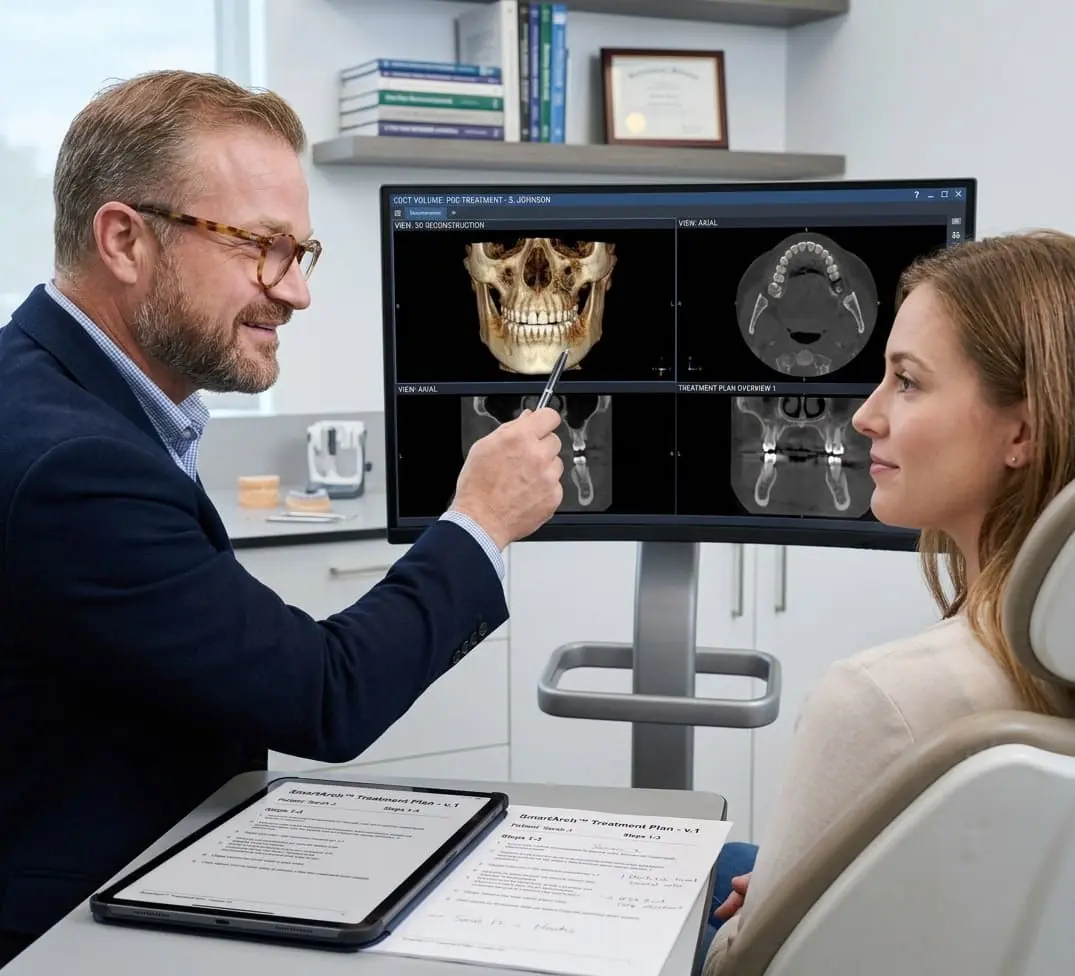
Step 1: Free Consultation & CBCT Scan
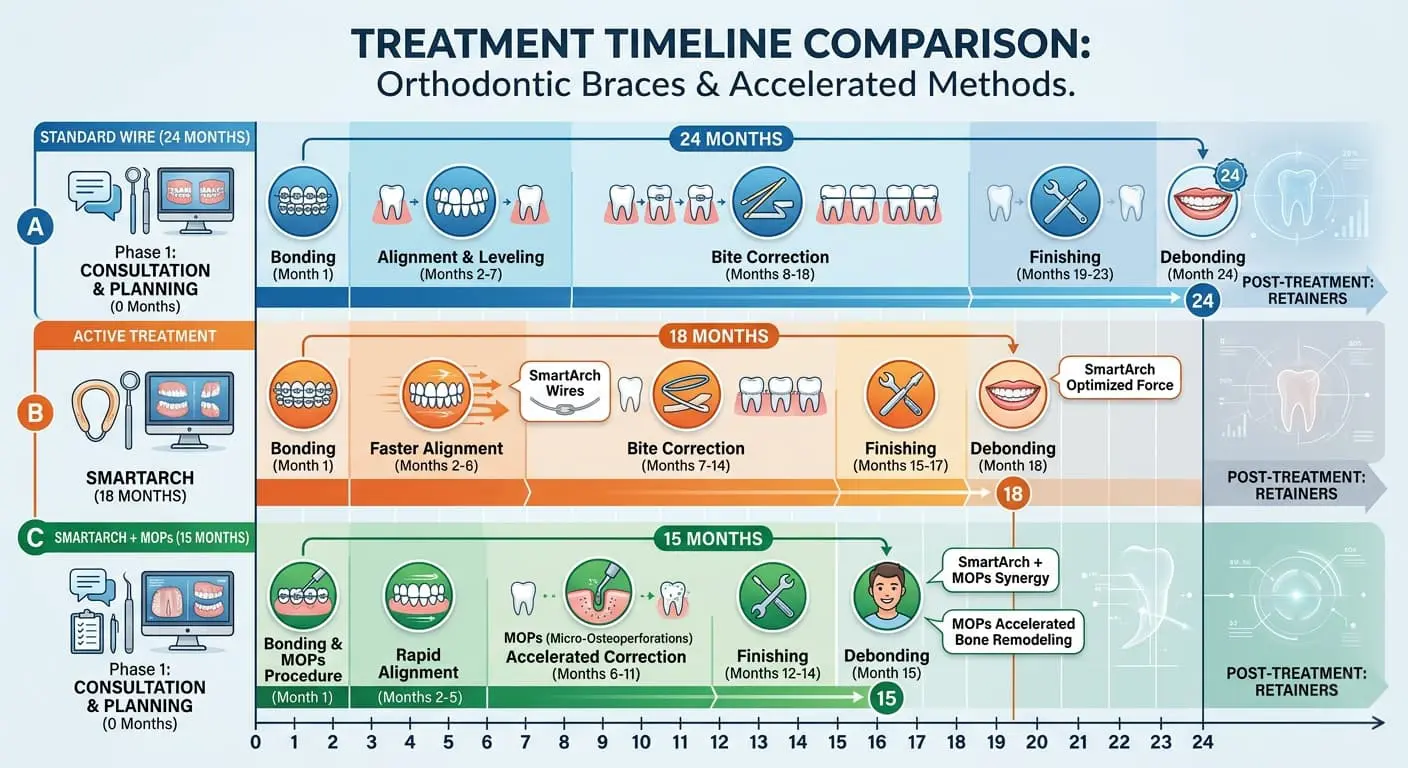
Dr. Viecilli evaluates the bite, reviews the patient’s dental and growth history, takes a CBCT scan (included at no cost for patients under 18 per Limestone Hills Orthodontics’ policy), captures an intraoral scan with Medit i700, and develops an individualized treatment plan. Standard comprehensive braces cases at Limestone Hills run 12 to 18 months. Complex cases involving significant bite correction, extractions, or skeletal coordination take 18 to 24 months. Phase 1 treatment for children typically completes in 6 to 12 months. SmartArch™ wire technology shortens many cases by matching force output to each tooth’s root size, so smaller front teeth do not absorb the same force as larger molars and the entire arch progresses on a more biologically efficient curve. Treatment time estimates are given at the free consultation and refined as the case proceeds. Every plan already includes SmartArch™ wire.
There is no upsell. If MOPs would meaningfully benefit the case, Dr. Viecilli will discuss that option and its cost during this visit.
Step 2: SmartArch™ Sequence (All Patients)
Instead of starting with a thin .014″ wire and progressing through 4–6 wires over 12+ months, SmartArch™ uses a 2-wire sequence: a round wire for initial alignment followed by a rectangular wire for 3D torque correction. Each wire stays in place longer because it delivers a sustained, appropriate force. Fewer wire changes, fewer appointments, faster progress.
Step 3: MOPs or Corticotomy (If Elected)
For MOPs: during a regular adjustment appointment, Dr. Viecilli uses a specialized instrument to create 3–5 tiny perforations in the bone adjacent to the teeth being moved. The procedure takes about 5 minutes. No stitches. Most patients resume normal activities immediately. MOPs can be repeated at subsequent appointments if the clinical response warrants it.
For corticotomy: Dr. Andrew Verrett at Austin Periodontal Associates performs the procedure in a separate surgical appointment. The periodontist makes small cuts in the cortical bone and places bone graft material. Recovery is typically 3–5 days. This option is reserved for complex adult cases where maximum acceleration and bone augmentation are both needed.
Step 4: Monitoring & Finishing
Progress is tracked with digital monitoring, including remote scans that let the clinical team catch a broken bracket, tracking drift, or compliance issue between in-office visits instead of at the next appointment. Because SmartArch™ produces more predictable tooth movement, mid-course corrections are less common, and finishing adjustments are typically simpler. Total treatment time for most patients is shorter than conventional protocols because finishing visits is driven by data rather than by a fixed calendar.
Acceleration Options for Aligner Patients
SmartArch™ is a braces-only technology because it is an archwire. For patients using Invisalign or Angel Aligners, the primary acceleration options are:
Micro-Osteoperforations With Aligners
MOPs work with any orthodontic system. For aligner patients, MOPs can be performed at check-up visits to stimulate faster bone response between aligner changes. This is particularly useful for adult patients whose bone is denser and respond more slowly to orthodontic forces.
Optimized Aligner Change Frequency
Rather than changing aligners on a fixed 14-day calendar, Limestone Hills Orthodontics uses remote monitoring to confirm when the prescribed movement is actually complete. Many patients can safely switch to seven- to ten-day changes once teeth are tracking. This effectively cuts the passive “waiting” time between scheduled visits.
This is guided by objective clinical assessment on each scan rather than by a one-size schedule, and it is the most reliable way to shorten an aligner case without compromising tracking or finishing quality.
How Much Does Accelerated Treatment Cost?
SmartArch™: Included With Every Braces Case
There is no separate charge for SmartArch™ at Limestone Hills Orthodontics. It is built into the standard braces fee, which starts at $4,000 for metal braces.
Micro-Osteoperforations: Optional
MOPs are an optional add-on. Many other practices charge $500–$1,000 for this procedure. During the free consultation, Dr. Viecilli will assess whether MOPs would meaningfully benefit the case and discuss pricing.
Financing
Frequently Asked Questions
How much faster are braces with SmartArch™?
Total treatment time savings depend on case complexity but typically range from 20% to 30% overall.
Is SmartArch™ included in the cost of braces?
What are micro-osteoperforations?
Do vibration devices like AcceleDent or VPro actually work?
AcceleDent’s manufacturer ceased operations. Limestone Hills Orthodontics does not offer vibration-based acceleration because the evidence does not support charging patients $800–$1,000 for a device that has not outperformed placebo in the better-designed studies.
What about low-level laser therapy for acceleration?
Can accelerated treatment be used with Invisalign or clear aligners?
For aligner patients, acceleration options include micro-osteoperforations can be performed at check-up visits to stimulate a faster bone response between aligner changes.
Is there anything families should NOT pay extra for to speed up braces?
Families should also be cautious about any “fast braces” marketing that promises six-month comprehensive treatment; short cases are appropriate for mild cosmetic cases, but comprehensive correction of bite, crowding, and facial balance still requires a biologically appropriate timeline.