
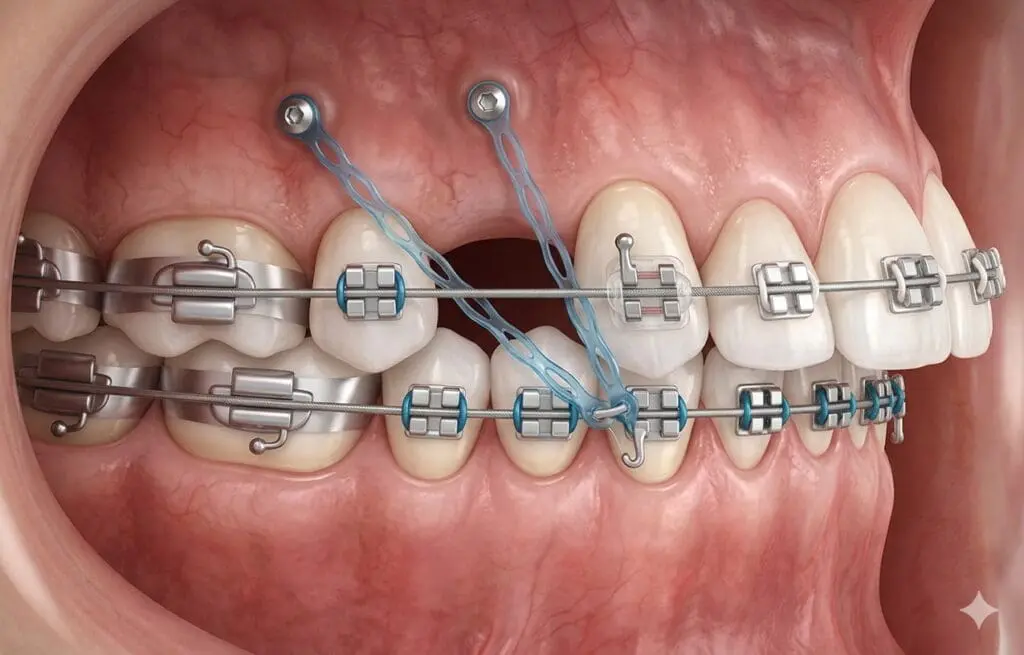
What Are TADs?
TADs (Temporary Anchorage Devices, also called orthodontic miniscrews, mini-implants, or micro-implants) are small titanium screws threaded directly into the alveolar or palatal bone to create a stable anchor point for tooth movement. They are removed once treatment is complete and the bone fills the small channel within weeks.
The screw itself is roughly the diameter of a toothpick and 6 to 10 millimeters long.
TADs solve one of the oldest challenges in orthodontics: moving one tooth without moving the teeth next to it. Before TADs, the only way to anchor an orthodontic force was against other teeth, which meant the anchor teeth would drift in the opposite direction.
This effect, called reactive movement, undermines the treatment plan and limits how aggressively certain movements (intrusion, distalization, single-tooth asymmetric correction) can be attempted. TADs eliminate reactive movement because they are anchored in bone, not in adjacent teeth.
Whatever force the wire or elastic applies, the screw holds fast.
Why TADs Are a Precision Tool
Applied to TADs, that training calculates the exact vector, magnitude, and duration of force needed to move a specific tooth in a specific direction without root resorption, bone loss, or TAD failure. Most orthodontists place TADs by rule-of-thumb protocols. Limestone Hills places them by biomechanics.
When TADs Are the Right Tool
TADs are not used in every case. They are the right tool when the required tooth movement cannot be achieved predictably with braces or aligners alone, or when conventional anchorage would produce unwanted reactive movement. The most common indications at Limestone Hills:
Molar Intrusion (Open Bite)
MARPE (Adult Palatal Expansion)
Impacted Canine Traction
Asymmetric Space Closure
Distalization (Severe Crowding)
Gummy Smile Correction
How TAD Placement Works at Limestone Hills Orthodontics
1
Free 3D CBCT Evaluation
Every new patient receives a complimentary i-CAT FLX CBCT scan at the consultation. The scan measures bone thickness, identifies tooth-root positions, locates nerves and sinus boundaries, and lets Dr. Viecilli plan the exact TAD position before any appliance is placed.
2
In-Office Placement (Same Day if Scheduled)
Placement takes roughly 10 minutes per screw. Dr. Viecilli uses a small amount of local anesthetic to numb the soft tissue, similar to a filling appointment. Patients describe the placement as mild pressure rather than pain. There is no drilling of tooth structure and no surgical flap. The screw is threaded directly through the tissue into the underlying bone.
3
Immediate Loading
Unlike dental implants, which require three to six months of osseointegration before they can hold force, TADs are designed for immediate loading. The orthodontic spring, elastic chain, or wire is attached the same day or within a week, and tooth movement starts.
4
Monitoring
Dr. Viecilli evaluates each TAD at every check-in for stability, tissue health, and movement progress. Loosening or migration is rare with bone-driven placement, but if it occurs, the TAD is replaced in-office the same day. Most TADs remain in place 4 to 8 months, depending on the planned tooth movement.
5
Removal
Once the planned movement is complete, the TAD is removed in-office in under 5 minutes, often without anesthetic because the screw is no longer integrated into bone. The soft tissue heals in a few days and leaves no visible scar. The bone remodels to fill the small channel within several weeks.
Why In-Office TAD Placement Matters
Most Austin-area orthodontists refer TAD placement to an oral surgeon. That referral pathway adds a separate consultation, a separate appointment, a separate copay, and typically two to six weeks of scheduling delay between the orthodontic plan and the start of TAD-supported tooth movement. Limestone Hills places TADs in the office, often the same day they are planned.
Dr. Viecilli places the TAD at the same visit where the appliance is adjusted. No outside surgeon, no second consultation, no waiting two to six weeks for the surgical office to schedule.
Oral surgeons place implants reliably, but they do not design the orthodontic force system. When the orthodontic designer and the surgical planner are different people, position errors happen at the millimeter level that the force calculation does not tolerate. Dr. Viecilli designs the biomechanics and places the TAD; the position is optimized for the force that will act on it.
When TADs are part of a comprehensive orthodontic treatment plan at Limestone Hills, they are included at no additional charge: no surgeon fee, no separate TAD fee, no anchorage supplement. Standalone TADs for non-comprehensive cases are priced separately and explained at the consultation before placement.
The CBCT scan locates the safe bone window in three dimensions. The placement is planned around root positions, sinus floor, and nerve canal coordinates specific to the patient. No standard-protocol templates applied across cases.
What Does It Feel Like?
The most common patient question before placement is what the TAD will feel like. Three honest data points from Dr. Viecilli’s clinical experience at Limestone Hills:
During Placement
Local anesthetic numbs the soft tissue first. Patients feel pressure as the screw threads into the bone, similar to the pressure of a filling. Not sharp pain. The procedure takes 10 minutes per screw, and most of that is preparation; the actual placement is under one minute.
First 24 to 48 Hours
Mild soreness in the surrounding tissue, similar to the day after a heavy braces tightening. Acetaminophen or ibuprofen handles the discomfort. Soft foods on the first day; normal eating returns within 48 hours.
Throughout the Treatment Phase
Most patients forget the TAD is there. The screw head is small enough to sit flush with the gum tissue. There is no constant awareness of the appliance, the way patients feel a new bracket or a new aligner.
When to Call
How Much Do TADs Cost?
TADs are included free when clinically indicated within a comprehensive treatment plan
Standalone or non-comprehensive TADs: $500 per device (placement, monitoring, removal)
The included-when-indicated structure is deliberate. TADs reduce reactive movement, shorten treatment time, and improve outcome predictability. Charging a separate fee for them creates a financial incentive to overuse them or, at the other extreme, to avoid them when they would benefit the case.
Limestone Hills folds TAD placement into the comprehensive treatment fee, so the recommendation is purely clinical rather than financial.
Most PPO orthodontic benefits apply to the comprehensive case the TADs support; medical insurance does not separately cover TADs. Standalone TAD cases (typically when a patient is transferred in from another practice and needs a single anchorage point) are quoted at consultation.
Financing
Frequently Asked Questions About TADs
Does TAD placement hurt?
How long do TADs stay in?
Are TADs the same as dental implants?
Will my insurance cover TADs?
Why does Dr. Viecilli place TADs in-office instead of referring out?
Position errors at the millimeter level affect outcome, and a single-operator pathway eliminates that handoff risk.