
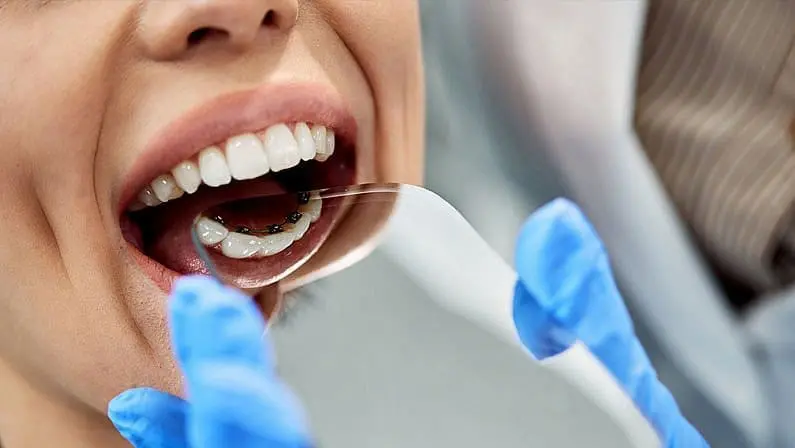
What Are Lingual Braces?
Lingual braces are orthodontic brackets and wires bonded to the back (lingual, or tongue-side) surfaces of the teeth rather than the front. Because the hardware faces inward, lingual braces are the only truly invisible fixed appliance. Nothing shows when the patient smiles or speaks.
They correct the same conditions as conventional braces: crowding, spacing, overbites, underbites, crossbites, and open bites.
Popular lingual systems include Incognito (by 3M), Harmony, the now-defunct InBrace, and Brava by Brius (the newest entrant). Each uses custom brackets manufactured to fit the contours of each tooth’s lingual surface. Treatment typically takes 18–36 months and costs between $7,000 and $13,000 at practices that still offer the category.
Roughly two to three times the cost of every other discrete option.
Why Limestone Hills No Longer Offers Lingual Braces
The decision was not about cost, complexity, or training. Dr. Viecilli stopped offering lingual braces because the patient experience was poor and the long-term reliability of the supply chain could not be guaranteed for families in Austin and the surrounding communities.
Four factors drove the decision. Each observed firsthand over years of lingual orthodontic practice.was
Manufacturer Instability
Lingual braces companies have repeatedly shut down or left the US market. InBrace is the most recent casualty. Patients were left mid-treatment with no replacement parts.
Incognito and Harmony have faced their own distribution and availability challenges. Brava by Brius is the newest entrant, but the fundamental market dynamic remains unchanged: low patient demand makes lingual braces economically fragile for manufacturers. When your custom brackets cannot be replaced, treatment stalls must restart with a different system entirely.
Severe Tongue Discomfort
The tongue is one of the most sensitive structures in the body. Lingual brackets press directly against it during speaking, eating, and swallowing. Research shows lingual braces cause more severe pain and longer recovery than front-facing braces or aligners.
Many patients experience a noticeable lisp lasting one month or more. A published study of 68 adults found lingual braces produced the most severe pain of all braces types.
Breakage & Emergency Delays
When a custom lingual bracket breaks or debonds, it cannot be replaced from office stock. It must be reordered from the manufacturer. A process that can take weeks.
During that time, treatment progress stops or reverses. With front-facing braces, replacement brackets are readily available in-office for same-day repair.
Disproportionate Cost
Lingual braces cost $7,000–$13,000. Significantly more than any alternative. The premium reflects custom manufacturing, specialized training, and longer chair time, not better outcomes.
Clear ceramic braces start at $4,600 and deliver equivalent discretion at conversation distance. Angel Aligners start at $4,000. Typically, the lower-cost clear option. And Invisalign starts at $4,700.
Exact pricing is confirmed at the consultation after Dr. Viecilli reviews the specific case.
Clear ceramic braces and modern aligners achieve the same discreet result without those risks, which is why Limestone Hills Orthodontics now routes discretion-focused patients there instead.
The Decline of Lingual Braces as a Category
Brava by Brius is the newest entrant, but early clinical feedback describes steep learning curves, extended tongue adaptation periods, and limited case-type suitability. The industry pattern is consistent: the discreet-treatment market has moved to clear ceramic brackets and aligners, not lingual systems.
Which is the category Limestone Hills now recommends.
Lingual Braces vs Clear Braces vs Invisalign
If discretion is your priority, these alternatives deliver comparable or superior invisibility with dramatically lower risk.
| Factor | Lingual (Discontinued) | Clear Ceramic Braces | Invisalign / Angel Aligners |
|---|---|---|---|
| Visibility |
100% hidden (behind teeth)
|
Translucent. Near-invisible at conversation distance
|
Clear removable trays. Nearly invisible |
| Tongue Pain |
Severe. Constant tongue contact
|
None. Brackets face outward
|
None. Smooth plastic |
| Speech Impact |
Lisp lasting 1+ months (research-confirmed)
|
Minimal. Brief adjustment
|
Minimal. Brief adjustment |
| Manufacturer Stability |
InBrace shut down; Incognito/Harmony uncertain; Brava newest in the same low-demand market
|
Established brands. No history of market exits
|
Invisalign (Align Tech) + Angel. Stable |
| Bracket Replacement |
Custom reorder. Weeks of delay
|
In-office replacement. Same day
|
N/A. Trays are replaceable |
| Starting Price |
$7,000–$13,000
|
From $4,600
|
Invisalign from $4,700 · Angel from $4,000 |
| Complex Cases |
Effective but limited by access
|
Full range. Same as metal
|
Mild to moderate preferred |
| Oral Hygiene |
Extremely difficult to clean
|
Moderate. Careful brushing needed
|
Easy. Remove trays to brush |
| Treatment Duration |
18–36 months
|
12–24 months (SmartArch™)
|
12–24 months |
| Offered at Limestone Hills |
No. Discontinued
|
Yes
|
Yes
|
Lower Entry
Angel Aligners start at $4,000. Less than half the cost of lingual braces, with near-total invisibility and zero tongue discomfort.
What Limestone Hills Recommends Instead
Patients in Austin who arrived on this page looking for invisible treatment have three strong options at Limestone Hills Orthodontics. Each is discreet in its own way, each backed by manufacturers with no history of market exits, and each priced at roughly half or less of what lingual braces cost. Dr. Viecilli will match the case to the right option during the free consultation.
Clear Self-Ligating Ceramic Braces
Invisalign & Angel Aligners
Modern Metal Braces
Lingual Braces FAQ
Why did Limestone Hills stop offering lingual braces?
(1) Company instability. Lingual braces manufacturers have repeatedly shut down or left the US market, leaving patients stranded mid-treatment. InBrace is the most recent example.
(2) Patient experience. Lingual braces cause significantly more tongue pain, speech impediment, and eating difficulty than any other braces type.
(3) Breakage risk. When custom lingual brackets break, they must be reordered from the manufacturer, delaying treatment by weeks.
Modern clear ceramic braces and clear aligners now achieve the same discreet appearance without these risks.
What are the best alternatives to lingual braces?
Both avoid the tongue pain, speech issues, and manufacturer instability risks of lingual braces.
How much do lingual braces cost?
The premium on lingual braces reflects custom manufacturing and longer chair time, not better outcomes. Use our cost calculator to see exact pricing for alternatives.
Are lingual braces more painful than regular braces?
Many patients experience a noticeable lisp that can last one month or more. A study of 68 adults found that lingual braces patients had the most severe pain of all braces types.
What happened to InBrace, Incognito, and other lingual braces?
This pattern of instability is a core reason Dr. Viecilli discontinued lingual braces. When a manufacturer exits, patients needing replacements have no recourse. This risk does not exist with established systems like metal braces, ceramic braces, Invisalign, or Angel Aligners.
Will Limestone Hills ever offer lingual braces again?
If a new lingual system emerges with proven long-term stability, in-office bracket replacement, and comparable comfort to modern alternatives, Dr. Viecilli will reassess. Until then, the recommendation remains clear ceramic braces or Angel/Invisalign.