

What Is Dental Crowding?
Dental crowding is the orthodontic term for teeth that lack enough room to align in the dental arch, producing rotation, overlap, displacement of one or more teeth out of the line of the arch, or impacted teeth that fail to erupt fully.
The functional consequences are real: crowded teeth trap plaque between contacts that floss cannot reach, produce uneven chewing forces that wear individual cusps asymmetrically, and (in moderate-to-severe cases) increase the risk of periodontal pocketing around displaced teeth.
Crowding is the most common orthodontic finding in the United States and is often present alongside other malocclusions (deep bite, crossbite, underbite). The severity is measured in millimeters of arch-length discrepancy on the digital intraoral scan. The cause (dental versus skeletal) is identified on the CBCT scan.
The right treatment depends on both numbers, not on the patient’s appearance alone.
Dental Crowding vs. Skeletal Crowding
Dental crowding is the simpler scenario. The jaw size is normal but the teeth are slightly larger than the available arch length, or one or two teeth have erupted out of position.
Treatment creates the missing space with interproximal reduction (IPR, a controlled enamel reshaping that removes 0.2 to 0.5 millimeters between contacts) or with mild arch development. Most adult-presenting crowding cases without a clear narrow-jaw pattern are dental.
Skeletal crowding is the more consequential scenario. The upper or lower jaw is physically narrower than the dental arch needs, often because of an early-life airway pattern (chronic mouth breathing, low tongue posture during growth) that constrained transverse maxillary development.
Treatment creates space at the bone level, not just the tooth level. Palatal expansion in growing children opens the midpalatal suture and produces real skeletal width; in adolescents and adults whose suture has begun fusing, MARPE (miniscrew-assisted rapid palatal expansion) accomplishes the same thing without surgery.
The CBCT scan at the consultation measures the transverse skeletal dimension directly so the dental-versus-skeletal call is made on imaging, not on a clinical guess.
Severity Levels: Mild, Moderate, and Severe
Before recommending a treatment, Dr. Viecilli measure the exact amount of crowding in millimeters using digital models and 3D CBCT imaging. That measurement determines whether aligners alone will work, whether expansion is needed, or whether braces are the right first appliance.
Mild – Less Than 4 mm
Moderate. 4 to 8 mm
Severe – More Than 8 mm
What Causes Crowded Teeth?
Crowding is multi-factorial. The most common drivers in the patients seen at Limestone Hills:
Wisdom teeth are NOT a primary cause of crowding. The research is clear on this point: erupting wisdom teeth do not generate enough force to push the rest of the dentition into crowded positions. Late crowding is driven by jaw morphology and aging, not by third-molar pressure.
Why Crowded Teeth Matter: Health Consequences
Mild crowding is primarily an aesthetic concern. Moderate-to-severe crowding produces measurable functional consequences that compound over time:
Why Early Treatment Matters for Crowding
The American Association of Orthodontists recommends a first orthodontic check around age 7 specifically because crowding patterns are easier to address while there is still skeletal growth available to redirect.
Limestone Hills evaluates every 7-year-old who comes through the consultation but does NOT recommend Phase 1 treatment for every child. Most growing children are placed on complimentary growth-monitoring recall (one visit every 6 to 12 months) until the records support starting treatment.
Phase 1 intervention is appropriate for a narrow set of structural problems where waiting would convert a 6-to-12-month early treatment into a 24-month adolescent treatment or, in the worst cases, a surgical adult correction:
Cosmetic crowding that growth is likely to resolve on its own is not a Phase 1 indication. Limestone Hills says so explicitly at the consultation rather than starting early treatment that does not change the outcome.
How Limestone Hills Treats Crowded Teeth
| Treatment | Best For | How It Creates Space | Starting Price |
|---|---|---|---|
| Metal Braces | All severity levels | Archwire forces + SmartArch (free, ~50% faster alignment) | $4,000 |
| Clear Ceramic Braces |
All levels (aesthetic preference)
|
Same mechanics, tooth-colored brackets
|
$4,600
|
| Invisalign |
Mild to moderate
|
Sequential aligners + IPR if needed
|
$4,700
|
| Angel Aligners Lower Entry |
Mild to moderate
|
Stiffer material for better force delivery
|
$4,000
|
| Palatal Expansion |
Children with narrow upper jaw
|
Widens the jaw itself (skeletal space)
|
From $500
|
| IPR |
Mild-moderate (1–3 mm needed)
|
Gentle enamel reshaping, 0.2–0.5 mm per contact
|
Included with treatment
|
Non-Extraction as the Default
Palatal expansion, IPR, distalization, and arch development can create space without removing permanent teeth. Dr. Viecilli evaluates every case with CBCT imaging to determine bone support. Extractions are recommended only when non-extraction approaches would compromise stability or periodontal health.
Limestone Hills’s Approach to Crowding
Three points distinguish the Limestone Hills approach to crowding from a generic comprehensive treatment plan:
Why Crowded Teeth Align Faster With SmartArch
Crowded teeth are the exact scenario where standard archwires fail most. A severely rotated incisor and a well-positioned molar sit on the same wire, but the incisor needs gentle force while the molar needs firm force. Standard wires deliver the same stiffness everywhere.
SmartArch solves this with seven programmed stiffness zones. The crowded anterior teeth receive light, sustained force in the optimal biological response window. Published research shows this approach reduces leveling and alignment time by approximately 50%.
Every braces patient at Limestone Hills Orthodontics receives SmartArch at no additional cost.
Phase 1 (Interceptive) Treatment for Crowded Baby Teeth
For children ages 7 to 10 with severe crowding driven by a narrow upper jaw, Phase 1 treatment opens the midpalatal suture with a custom palatal expander and creates the skeletal arch length the permanent teeth need to erupt straight.
The active expansion phase runs 10 to 14 days; the appliance then sits passively for 4 to 6 months while new bone fills the suture. Many Phase 1 cases need no further treatment until the permanent dentition has fully erupted, at which point the family decides whether comprehensive Phase 2 treatment is needed for residual finishing.
Phase 1 fees at Limestone Hills are quoted at the consultation once the dental-versus-skeletal classification is made. For families who later need Phase 2 comprehensive treatment, the Phase 1 fee is credited toward the comprehensive case so the total cost is the same as starting fresh at age 12 or 13.
The savings come from avoiding extractions, surgical exposures of impacted canines, and orthognathic surgery later. See the children’s orthodontics page for the full Phase 1 protocol.
Typical Treatment Timeline
The timeline below is a realistic range based on crowding severity. Every case is individual; Dr. Viecilli confirm exact timing after digital records at the consultation.
| Severity | Braces Timeline | Aligners Timeline | Visits |
|---|---|---|---|
| Mild (<4 mm) | 6–12 months | 6–12 months | Every 6–10 weeks |
| Moderate (4–8 mm) |
12–18 months
|
12–18 months
|
Every 6–10 weeks
|
| Severe (>8 mm) |
18–24+ months
|
Often not suitable
|
Every 6–8 weeks
|
How Long Should Crowding Treatment Really Take?
Treatment time depends on three variables: the millimeters of arch-length discrepancy, whether expansion is part of the plan, and whether the case includes additional malocclusion components (deep bite, crossbite, underbite). A pure mild crowding case with no other findings finishes in 6 to 12 months.
A moderate case with expansion plus alignment runs 12 to 18 months. A severe case with skeletal expansion, alignment, and detailing can run 18 to 24 months end-to-end.
SmartArch wire shortens the leveling-and-alignment phase of every crowded case by approximately 50 percent in published clinical data. The total treatment-time savings are typically 3 to 6 months on a comprehensive case. Limestone Hills quotes a realistic range at the consultation rather than a marketing-driven minimum that few cases actually achieve.
What to Expect at a Limestone Hills Crowding Consultation
The consultation is free, and there is no obligation to start treatment at Limestone Hills. Austin and the surrounding communities families leave the first visit knowing the severity of the crowding, the full list of options, and what each will cost.
Before & After
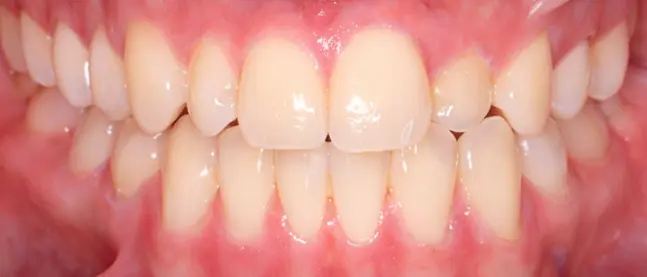
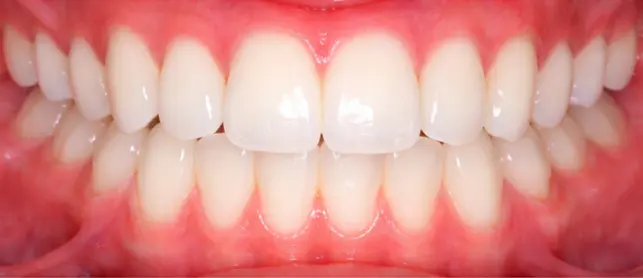
Crowding: Invisalign/Clear Aligners
More crowding cases are in the Limestone Hills treated cases gallery, with severity level, treatment type, and timeline noted for each.
How Much Does It Cost to Fix Crowded Teeth at Limestone Hills?
Phase 1 (early treatment): Braces from $2,000 · Angel from $3,000 · Invisalign from $3,700 · Palatal expander From $500
Financing at Limestone Hills
Most PPO orthodontic plans cover a portion of the comprehensive case the crowding treatment is part of. Community discounts (military, teachers, first responders, healthcare workers, family) apply when the treatment is comprehensive. Limestone Hills verifies dental benefits at the consultation.
Common Appliances Used at Limestone Hills
Treatment for crowding follows the case: metal or ceramic braces for moderate to severe cases where root control and bite correction matter, and clear aligners for mild to moderate crowding in patients ready for the responsibility of removable treatment. A palatal expander is added when the arch needs more room before alignment begins.