

What Is a Crossbite?
In a normal bite, the upper teeth sit slightly outside the lower teeth. Like a lid fitting over a box. In a crossbite, this relationship is reversed: one or more upper teeth bite inside the lower teeth. The reversal can involve the front teeth (anterior crossbite), the back teeth (posterior crossbite), or both.
It can affect one side of the mouth (unilateral) or both sides (bilateral). Each variant has a different cause, a different urgency, and a different treatment.
Posterior crossbite is far more common than anterior, affecting 4–17% of children depending on the population studied. Anterior crossbite affects 4–5% of children and is often an early warning sign of a developing underbite (Class III skeletal pattern).
Many crossbites are missed at general pediatric-dental checkups because they only show up clearly when the child bites all the way down and the midlines of the upper and lower teeth are compared side by side.
Limestone Hills Orthodontics serves families across Austin, TX and the surrounding Austin-area communities. Dr. Viecilli evaluates every new patient for crossbite at the first consultation. With particular attention to the functional shift pattern that most general dentists and pediatric dentists do not routinely screen for.
The Four Crossbite Patterns
Posterior Crossbite (Back Teeth)
One or more upper back teeth bite inside the lower back teeth. The most common cause is a narrow upper jaw. The maxilla is too narrow relative to the mandible. Contributing factors at the Limestone Hills new-patient consult include a history of thumb sucking, prolonged pacifier use, chronic mouth breathing, large tonsils or adenoids, and a family history of narrow palates.
The critical concern with posterior crossbite is the functional mandibular shift that most unilateral cases carry. The lower jaw slides to one side when the child closes their mouth, just to make the teeth fit together. This shift is the reason posterior crossbite is one of the few conditions the doctors treat as soon as it is diagnosed, even in baby teeth.
Anterior Crossbite (Front Teeth)
One or more upper front teeth bite behind the lower front teeth. This can involve a single tooth that simply erupted in the wrong position (a dental crossbite), or all four front teeth in what is often a developing Class III / underbite pattern (a skeletal crossbite). At Limestone Hills, CBCT imaging distinguishes the two because the treatment paths diverge dramatically.
When only one or two teeth are involved, the cause is usually dental and correction is fast. Often a few months. When all front teeth are involved, a skeletal component is likely and the plan expands to include palatal expansion and sometimes a reverse-pull facemask to advance the upper jaw during the growth window.
Unilateral Crossbite (One Side)
A crossbite on only the right or only the left side. Almost always comes with a functional shift. This is the most common variant in children aged 5–11 and also the most urgent, because the asymmetric bite drives asymmetric jaw growth if left unaddressed through the mixed-dentition years.
Bilateral Crossbite (Both Sides)
Posterior crossbite on both sides of the mouth. Usually skeletal in origin. The upper jaw is symmetrically narrow rather than shifted. Bilateral crossbite does not cause a lateral mandibular shift, but it still affects breathing, chewing, and long-term tooth wear and is treated with palatal expansion.
Skeletal vs Dental Crossbite: Why the Distinction Matters
Every crossbite falls somewhere on a spectrum between pure dental (a tooth is tipped the wrong way) and pure skeletal (the upper jaw bone is the wrong size or position). At Limestone Hills, the first job at a crossbite consultation is to place each case correctly on that spectrum, because the treatment path is different.
Dental Crossbite
The jaw bones are the correct size and in the correct position, but one or more teeth tipped in the wrong direction as they erupted. Seen most often with a single upper lateral incisor that came in behind a lower tooth, or a single upper molar that flared inward. Treatment is focused on moving the affected tooth with limited braces, a removable spring, or clear aligners.
Skeletal Crossbite
The upper jaw is too narrow (transverse deficiency) or the lower jaw is disproportionately wide or forward. Skeletal posterior crossbite in children is the textbook indication for palatal expansion while the midpalatal suture is still open. Typically before age 12–14. Skeletal anterior crossbite often indicates a developing Class III pattern and is covered in detail on the underbite page.
Combined (Most Common in Older Children)
Both components are present. The jaw is narrow, and the teeth have compensated by tipping inward on the crossbite side. Treatment uses expansion to correct the skeletal component and then aligners or braces to upright the teeth.
The Functional Shift: Why Unilateral Crossbite Is Urgent
This is the concept most parents are never told at a routine dental cleaning. When a child has a unilateral posterior crossbite, the upper jaw is narrower on one side than the other. To make the teeth fit together, the lower jaw shifts laterally toward the crossbite side every single time the child closes their mouth.
This is called a functional mandibular shift, and it is the single most important feature to identify at the first crossbite exam.
Initially, the shift is muscular. The muscles guide the jaw into a position where teeth can meet. But children grow. During active jaw growth, the condyle on the crossbite side remodels differently than the opposite side because it is loaded differently.
Over months and years, what started as a muscular adaptation becomes a permanent skeletal asymmetry: the jaw and face literally grow unevenly, the chin deviates toward the crossbite side, and the midline of the face shifts.
This cannot be reversed once it becomes skeletal. A functional shift corrected in childhood with a simple palatal expander takes roughly 2–4 weeks of active expansion plus a retention phase. The same asymmetry in an adult who was never treated often requires orthognathic jaw surgery to correct. Early intervention is one of the clearest cost-benefit cases in all of orthodontics.
How Limestone Hills Diagnoses the Shift
Dr. Viecilli checks for a functional shift at every new-patient consultation by guiding the jaw into centric relation (true, unstrained jaw position) and comparing that to centric occlusion (where the teeth naturally come together when the child bites down).
If the lower dental midline deviates to one side when the child closes, a functional shift is present. A low-dose cone-beam CT scan then confirms the skeletal transverse dimensions and tells the doctors whether the crossbite is dental, skeletal, or combined. The distinction that determines whether expansion is truly indicated.
For families in Austin and the surrounding Austin communities, this functional-shift assessment is included in the complimentary new-patient consultation at Limestone Hills. No referral is required.
When Limestone Hills Treats Crossbite Early – Often in Baby Teeth
Dr. Viecilli only recommends early treatment when waiting would cost more time, money, or surgical risk later. Most children are better served by monitored growth observation until permanent teeth emerge and skeletal patterns stabilize. When early intervention is warranted, the clinical reason is specific: a crossbite causing asymmetric jaw growth, a severely impacted canine path, an airway-driven palatal narrowing, or a habit (thumb, tongue thrust) that will reshape the bite if left uncorrected. Limestone Hills runs a free Growth Observation Program for children who need monitoring rather than immediate treatment.
In crossbite specifically, Dr. Viecilli generally recommends palatal expansion as soon as a functional shift is confirmed, even if the child still has primary (baby) teeth. The midpalatal suture responds best to expansion between ages 5 and 11, and the shorter the asymmetry has been present, the cleaner the correction.
Waiting “until all the adult teeth come in” is exactly the timing error that turns a 2-week expander case into an adult surgery case.
How Limestone Hills Treats Crossbite
Posterior Crossbite in Children: Rapid Palatal Expander
A rapid palatal expander (RPE) is the definitive treatment for posterior crossbite caused by a narrow upper jaw in a child with an open midpalatal suture.
The appliance cements to the upper molars and applies a gentle widening force across the palate; over 2–4 weeks of daily at-home turns by a parent, the two halves of the upper jaw separate at the suture and new bone fills in. The expander then stays in place unturned for 3–6 months as a retainer while that new bone matures.
Active expansion itself is not painful for most children. Mild pressure and a brief feeling of tightness are typical the evening after a turn, and a small gap can appear temporarily between the upper front teeth during expansion. A normal and welcome sign that the suture is opening. That gap closes on its own as the teeth settle.
What the Cochrane Review Found
A Cochrane systematic review of posterior-crossbite treatments confirmed that both quad-helix (fixed) appliances and expansion plates (removable) effectively correct posterior crossbite in children, with quad-helix probably more effective of the two.
For adolescents, the review found no significant difference in outcomes between Hyrax and Haas expander designs. Dr. Viecilli selects the appliance based on the individual case.
Including whether the child has finger-sucking habits, the molars available for anchorage, and the family’s preference between fixed and removable designs.
Anterior Crossbite: Depends on the Cause
Single-tooth dental crossbite. A removable appliance with a spring, limited braces on the front teeth, or a bonded expander with anterior bite planes can move the affected tooth forward. These cases are often corrected in 3–6 months at Limestone Hills.
Multi-tooth or skeletal anterior crossbite. May indicate a developing Class III pattern. Treatment typically combines palatal expansion with a reverse-pull facemask to redirect upper-jaw growth forward during the critical ages 7–10 window. See the underbite page for the full protocol.
Adult Crossbite: MARPE, SARPE, or Surgical Expansion
After the palatal suture fuses. Typically around age 12–14 in girls and slightly later in boys. Traditional tooth-borne expansion is no longer reliable. Adults with skeletal posterior crossbite may be candidates for MARPE (mini-screw-assisted rapid palatal expansion).
MARPE uses four small titanium mini-screws placed in the palate to engage the bone directly, bypassing the teeth as anchors and allowing expansion even in a partially fused suture.
For more severe or older adult cases where MARPE is not predictable, Limestone Hills coordinates surgically assisted rapid palatal expansion (SARPE) with an oral surgeon. The surgeon performs a short outpatient procedure to release the suture; the expander then widens the jaw predictably over 2–4 weeks.
Invisalign or braces complete the alignment. This integrated, two-doctor pathway is a routine part of the adult-crossbite plan at the practice.
Dental-Only Crossbite in Adults
Adults whose crossbite is purely dental. The jaw is fine, individual teeth are tipped. Can often be corrected with comprehensive Invisalign, clear aligners, or braces without any expansion at all. These cases run 12–18 months on average and require no surgical step.
Treatment Options Comparison
| Treatment | Best For | Duration | Starting Price |
|---|---|---|---|
| Palatal Expander (RPE) | Children ages 5–11, posterior crossbite with open suture | Active: 2–4 weeks; retention 3–6 months | Phase 1 fee |
| Quad-helix | Children, mild to moderate constriction | 6–12 months | Phase 1 fee |
| MARPE | Teens/adults with fused or partially fused suture (expansion phase only) | Active: 4–6 weeks; retention 6–9 months | Part of comprehensive fee |
| MARPE + Metal Braces | Teens/adults needing expansion and full alignment (most common) | 4–6 weeks expansion + 12–18 months braces | from $8,000 ($3,000 down) |
| MARPE + Angel Aligners | Teens/adults preferring clear-tray alignment after expansion | 4–6 weeks expansion + 12–18 months aligners | from $9,000 ($4,000 down) |
| SARPE + Expander | Adults with fully fused suture or severe transverse deficiency | Surgical + 4–6 weeks active + retention | Coordinated with oral surgeon |
| Reverse-Pull Facemask | Skeletal anterior crossbite, children 7–10 | 6–12 months | Phase 1 fee |
| Metal Braces | Post-expansion alignment or dental crossbite | 12–18 months | from $4,000 |
| Invisalign | Mild dental crossbite, cosmetically motivated adults | 12–18 months | from $4,700 |
| Angel Aligners ← Lower Entry | Mild dental crossbite, price-sensitive adults | 12–18 months | from $4,000 |
What Happens If a Crossbite Is Not Treated
The most common reason parents delay crossbite treatment is the hope that the bite will self-correct as the child grows. Published studies consistently put that self-correction rate between 0% and 9%. In practice, the crossbite almost always persists, and over time it drives a cluster of secondary problems.
Skeletal Asymmetry
The functional mandibular shift becomes structural. The jaw grows unevenly. The chin deviates to one side, the condyles remodel asymmetrically, and the facial midline shifts. Once the asymmetry is skeletal, it is only correctable with orthognathic surgery in adulthood.
Premature Tooth Wear
Teeth in crossbite contact the opposing teeth at abnormal angles. The cusps wear unevenly, enamel thins on the wrong surfaces, and any restorations (fillings, crowns) placed on these teeth fail earlier than they should because the bite forces are misdirected.
TMJ Symptoms
A shifted jaw position loads one temporomandibular joint more than the other. Over years, that asymmetric loading can produce clicking, episodic pain, morning jaw stiffness, and degenerative changes on the overloaded side. Symptoms that may not appear until the late teens or adulthood but that are traceable to an unaddressed childhood crossbite.
Gum Recession
Teeth tipped into crossbite position often have thin buccal bone on one side. Abnormal forces accelerate bone loss and gum recession on these teeth, particularly the lower premolars and molars. The treatment plan at Limestone Hills accounts for this overlap between orthodontic forces and periodontal consequences.
One-Sided Chewing and Muscle Asymmetry
Children with crossbite instinctively chew on the non-crossbite side because the crossbite side is mechanically inefficient. Over years this creates asymmetric jaw-muscle development, reinforces the jaw shift, and contributes to facial asymmetry that was originally only skeletal.
Breathing and Airway Effects
A narrow upper jaw is also a narrow nasal floor. Children with posterior crossbite from transverse deficiency frequently have higher rates of mouth breathing, nasal congestion, and disrupted sleep. Palatal expansion has been shown in multiple studies to improve nasal airflow as a secondary benefit of correcting the crossbite.
Typical Treatment Timeline
| Stage | Duration | What Happens |
|---|---|---|
| Records & shift assessment | 1 visit | Digital scan, clinical photos, CBCT, CR-CO comparison, functional-shift diagnosis |
| Expander delivery | 1 visit | RPE cemented or bonded to upper molars; turn instructions to parent |
| Active expansion | 2–4 weeks | Daily turns at home until the bite is slightly over-corrected |
| Retention with expander in place | 3–6 months | New bone fills the expanded suture; no more turns |
| Monitoring (if no Phase 2 yet) | Recall every 6–12 months | Growth monitored through mixed-dentition years |
| Phase 2 comprehensive (if needed) | 18–24 months | Braces or aligners once all permanent teeth erupt |
What to Expect at the Limestone Hills Crossbite Consultation
Digital intake
Breathing history, thumb-sucking or pacifier habits, family history of narrow palates or jaw surgery, any prior dental referrals for the bite.
Comprehensive records
Digital intraoral scan, clinical photos, and a complimentary low-dose CBCT for transverse-dimension analysis and root / airway context.
Functional-shift check
Dr. Viecilli guides the jaw into centric relation to detect hidden shifts that are invisible when the child simply bites down naturally.
Diagnosis
Dental, skeletal, or combined. Unilateral or bilateral. Phase 1 indicated now, or observation with the next checkpoint scheduled.
Treatment plan with timeline
Expansion protocol if indicated, whether a Phase 2 comprehensive is anticipated, and how the plan coordinates with the pediatric dentist or general dentist currently seeing the child.
Exact pricing
Phase 1 fee if applicable, insurance benefits check, OrthoSync in-house financing terms, and any community discounts the family qualifies for.
Before & After
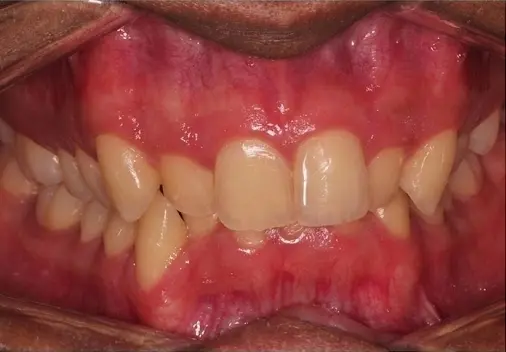
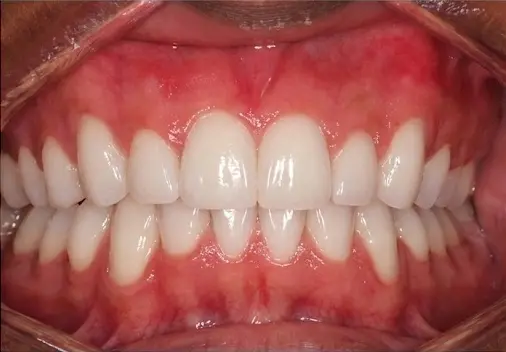
Deep Overbite: Braces with Bite-Pads
See more crossbite cases in the treated-cases gallery.
How Much Does Crossbite Treatment Cost in Austin?
Many crossbite cases in children are resolved with expansion alone. Comprehensive braces or aligners may not be needed until the permanent teeth have fully erupted, and in a meaningful share of cases they are not needed at all.
Insurance & Financing
Palatal expansion for crossbite correction is typically covered by dental insurance when documented as a malocclusion, subject to the orthodontic lifetime maximum. Limestone Hills accepts most major PPO plans and files insurance claims directly. OrthoSync: 0% interest, no credit check, low down payment.
Common Appliances Used at Limestone Hills
Posterior crossbite is almost always corrected with a palatal expander, which widens the upper jaw and eliminates the lateral jaw shift before it can affect growth. When the midpalatal suture has already fused in older teens and adults, Dr. Viecilli places the expander using temporary anchorage devices (TADs) in-office, a protocol known as MARPE.